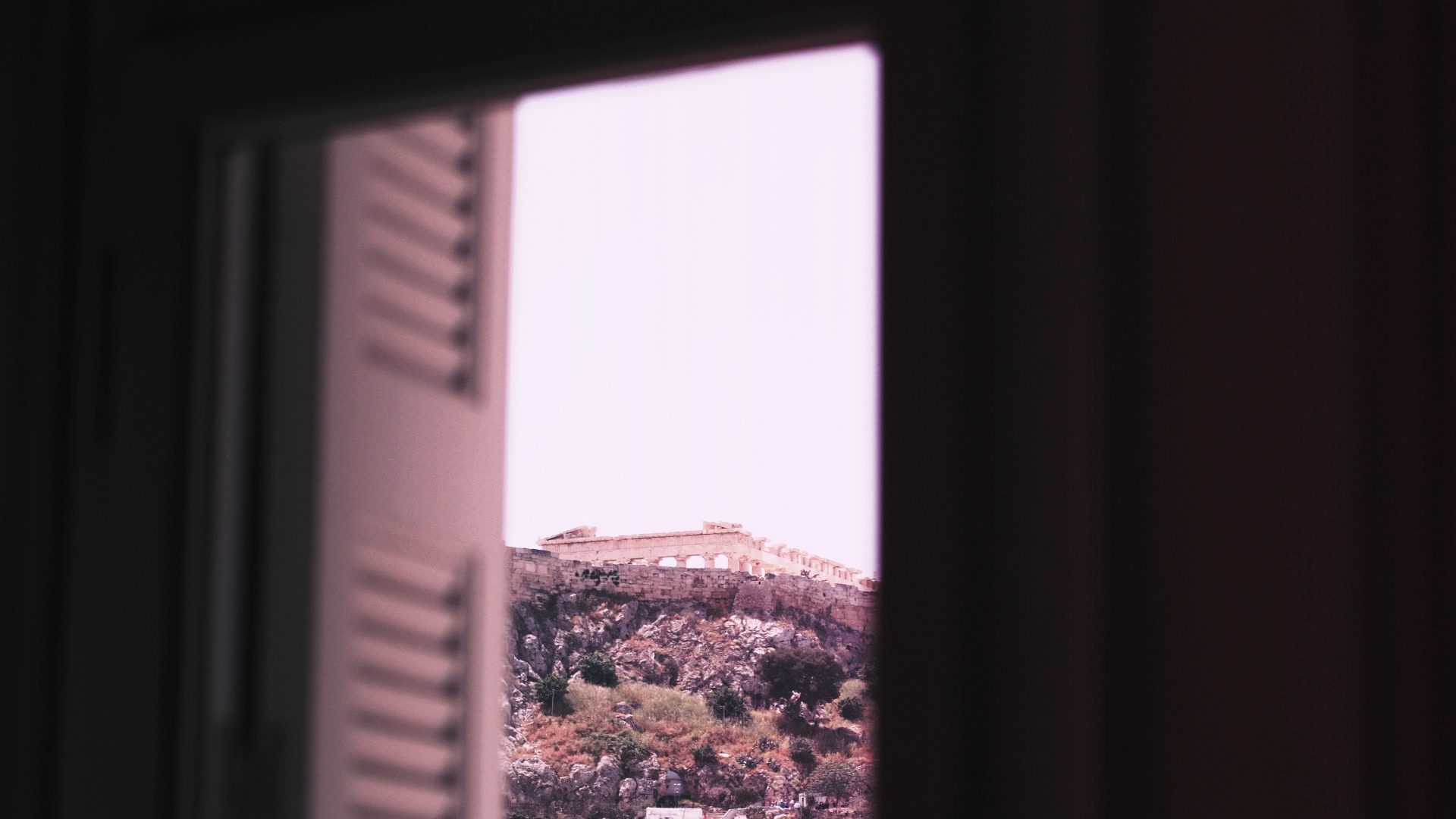
A reflection from Athens – through the lens of my camera
There is something about photographing a conference that changes how you experience it. You stop being a passive audience member and start reading rooms differently. You are watching for the moment a speaker’s point lands, or the side conversation that breaks out the instant a panel ends.
You are close enough to hear everything, but just far enough removed to notice things others might miss.
That was my position at the World Beautiful Business Forum in Athens. Together with Lara Sperber, Art Director at Hotwire, we formed a small production duo.
While our colleagues Grant Toups, Ute Hildebrandt and Anol Bhattacharya – Grant and Anol as part of the program – represented Hotwire in the conversations, Lara and I captured them. Hotwire sponsored the Agentic Agora track, which made our presence both commercial and curatorial.
Over four days, in roughly 25 degrees of Athenian sun, we followed the conversations wherever they went.
This is a reflection on what we witnessed.
The House of Beautiful Business is not a hype machine
This forum isn’t built on glossy optimism – it’s built on rigor. The sessions are designed to move beyond questions and into real, challenged attempts at answers.
It would be easy to dismiss a forum with “Beautiful” in its name as a gathering of optimists who prefer aesthetics over substance. That would be wrong.
The World Beautiful Business Forum is a serious intellectual event. The House of Beautiful Business brings together thinkers, practitioners and leaders who are not content with surface-level answers, and the format is built to reflect that.
Sessions are designed to push beyond the question and into the uncomfortable territory of possible responses. Not comfortable ones. Not tidy ones. Actual attempts at answers, examined from multiple angles, challenged in the room.
That rigor was the first thing that struck me. In an industry full of conferences where the same ideas circle endlessly, Athens felt different.
The questions being asked were hard. The people asking them were not looking for reassurance.
Observation one: Tough questions deserve real answers – and this forum actually tries
This format doesn’t stop at asking big questions – it creates the conditions to work through possible answers in public. And some of the most valuable moments happen off-stage, in Q&A and in the conversations that follow.
Most professional conferences are built around the question. The panel poses it, the audience nods, and everyone leaves slightly more informed but no closer to resolution.
The World Beautiful Business Forum operates differently. The format creates the conditions for people to actually work through the possible answers – not arrive at them neatly but move toward them seriously.
That distinction matters more than it might sound. When we are navigating questions about the future of technology, work, creativity and society, the habit of leaving questions permanently open is not neutral.
It is a way of avoiding accountability. The conversations in Athens were not comfortable, but they were committed.
People argued. They disagreed. They offered incomplete answers and let those answers be challenged.
As a content creator, you hear these exchanges differently because you are not taking notes or preparing your follow-up question. You are waiting for the visual moment.
What I noticed, instead, was how often the most interesting thing said in a session was not on the main stage – it was in the Q&A, or on the streets immediately after, when someone who had been sitting quietly for forty minutes said the thing that reframed everything.
Those moments do not make it into the official recap. They are the real value of being in the room.
Observation two: AI is everywhere – but not everyone it claims to serve is in the conversation
AI dominated the forum, but the tone wasn’t hype – it was scrutiny and accountability. A key tension surfaced: AI’s promise of democratization depends on who is represented in the input, not just who can access the output.
It would be dishonest to pretend AI was not the dominant thread running through the forum. It was.
What surprised me was the quality of the scrutiny.
The Agentic Agora track – which Hotwire sponsored – was built around the emerging reality of AI agents: systems that don’t just respond, but act.
The conversations were technically informed and practically grounded. What they were not was uncritical.
The forum did not treat AI as an inevitability to be welcomed or a threat to be managed. It treated it as a set of choices, still being made, by people who need to be held accountable for them.
One of the sharpest observations of the forum came from strategist Zoe Scaman, amongst others, who addressed the gap between AI’s promise of democratization and its current reality.
The claim is familiar: AI will make information and technology available to everyone. The reality is more complicated.
AI systems are built on input. The sources, voices and perspectives that feed those systems shape what they produce and who they serve.
Right now, that input skews heavily toward a select group. The voices of the majority of the world’s population are underrepresented in the data that defines how these systems understand humanity.
That is not a technical problem. It is a structural one.
And as Scaman pointed out, it is not fixed by making the output more accessible – it is fixed by ensuring the input is more representative.
That argument stayed with me for the rest of the conference. It reframed a lot of what I was hearing.
Observation three: Not every conversation was about AI – and that matters
The forum held space for urgent conversations beyond AI, treating them as equally important rather than folding everything into a single tech narrative. That balance protected the distinct stakes and expertise of each topic.
I want to name this directly, because it was one of the things I was most relieved to witness.
Alongside the AI discourse, the forum held space for conversations about journalism and the freedom of the press, inclusion and representation, the future of art and creative practice, and what it means to build organizations that reflect genuine human values.
These conversations were not positioned as counterpoints to the technology track. They sat alongside it as equally urgent.
That balance felt intentional and important. The risk at any technology-adjacent conference is that everything becomes a subcategory of AI: AI and journalism, AI and inclusion, AI and art.
What the World Beautiful Business Forum resisted, at least in the sessions I observed, was that flattening. These are distinct conversations with their own histories, stakes and expertise. They deserve to be treated as such.
A closing thought: we still have influence over this
The most significant takeaway wasn’t a single panel – it was agency. The input that trains AI models is still being shaped, and people who produce and publish knowledge have more influence over it than they often realize.
The most significant realization I took home from Athens was not about any single panel or speaker. It was about agency.
There is a tendency to discuss AI development as something that is happening to us – a force being shaped by a small number of technology firms operating largely beyond public accountability.
That is not entirely wrong. But it is not the whole picture.
The information that trains the models shaping our future is not fixed. We – as organizations, as communicators, as practitioners who produce and publish and archive knowledge – have more influence over that input than most of us currently exercise.
The question of what sources, voices and perspectives are represented in those systems is not decided once and sealed. It is ongoing. And it is, to a meaningful degree, ours to influence.
One thought I have carried since Athens: could the quality of thinking generated at forums like this – the arguments, the challenges, the nuanced positions that resist easy summary – be formally offered as a source of input to large language models?
Not as a gimmick, but as a genuine act of intellectual stewardship. An attempt to ensure that the systems being built on our collective knowledge actually reflect the depth of that knowledge.
That is the kind of question the World Beautiful Business Forum is built to take seriously. I am glad we were there to capture & witness it.
— Frank van de Koppel, Director Creative Strategy