
Last month, AMEC launched the GEO Principles at its Global Summit in Dublin and I had the pleasure of attending, alongside colleagues from Ketchum, FleishmanHillard, Big Valley Marketing and Converseon, and with input from practitioners, vendors and AMEC’s Academic Advisory Group.
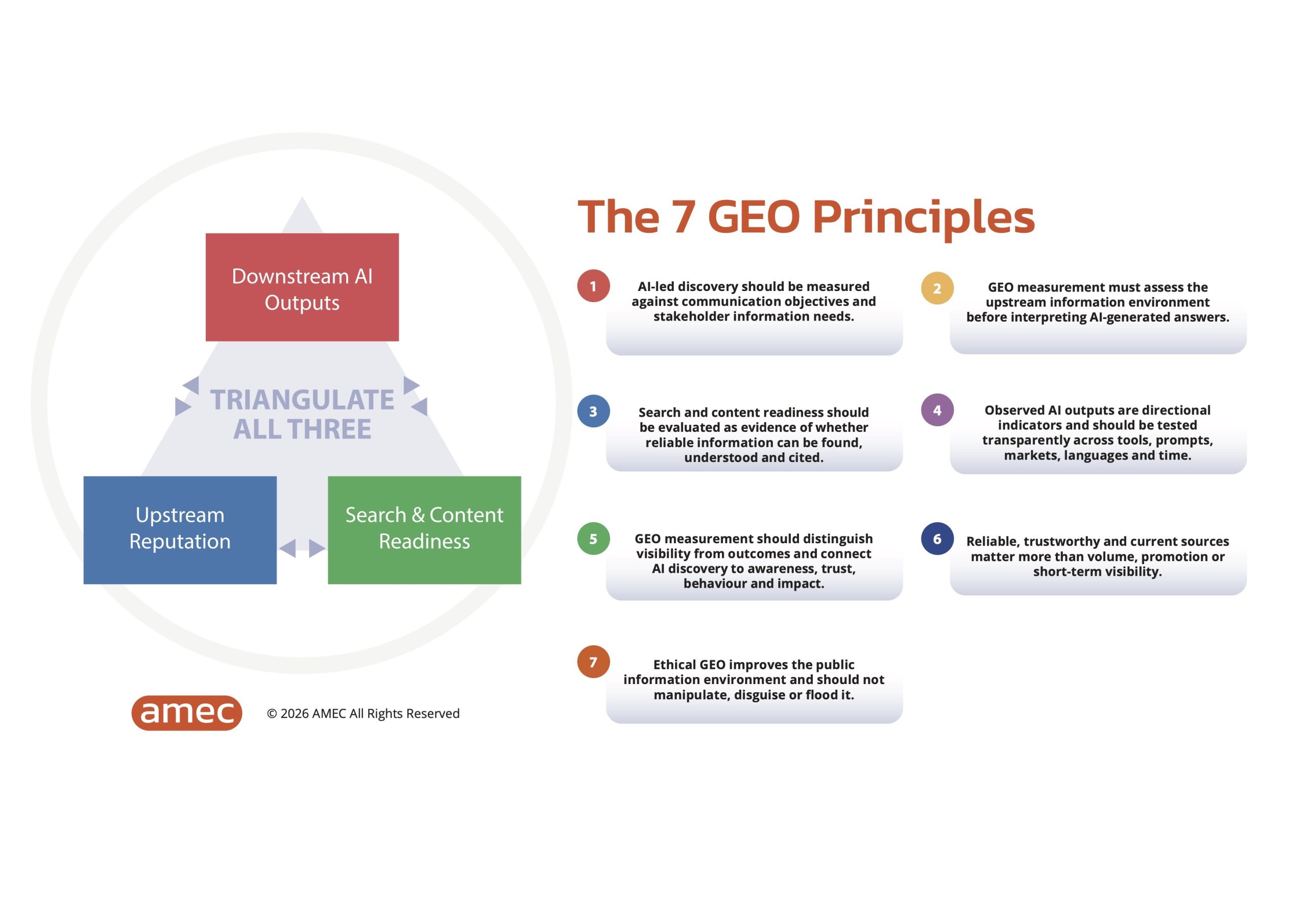
The principles represent the first industry-wide framework for measuring how organizations are found, described and represented in AI-generated discovery environments. They are a significant moment for communications measurement — and for us at Hotwire, a validation of the approach we have been building into our GEO consultancy from the start.
GEO is becoming a core discipline and stakes are high on both sides
Generative Engine Optimization has moved from emerging topic to fundamental discipline in the marketing and communications mix, and it has done so quickly. The audiences our clients need to reach are increasingly discovering, comparing and evaluating brands, organizations and issues through AI search environments — ChatGPT, Gemini, Copilot, Google AI Overviews.
The traditional search journey that communications strategies were built around is being structurally disrupted.
That creates a significant opportunity. For the first time, we can understand with real precision how information about a brand is being presented to audiences within AI environments — the narratives pulling through, the sources being cited, the framing being applied, the competitors being positioned alongside.
That intelligence, used well, fundamentally changes how we build PR programs, identify media opportunities, develop content strategy and advise on reputation risk.
But it also brings real risk if best practice is not applied. Inflated claims about AI visibility built on narrow or opaque methodology. Poor quality content flooding AI environments.
Inaccurate information amplified at scale across the channels audiences are increasingly trusting as authoritative. The AMEC GEO Principles are designed to challenge all of that — and the standard they set is the standard we hold ourselves to.
A framework that turns signals to action
Our GEO consultancy is structured around the three connected measurement areas that sit at the heart of the AMEC Principles: upstream reputation signals, search and content readiness, and downstream AI outputs.
We deliver that through Hotwire Spark and Hotwire Radiate, connected by the analytical and strategic consultancy layer that turns signals into intelligence and intelligence into action.
Context engineering: the foundation of meaningful insight
The quality of GEO analysis is determined by the quality of the prompts used to generate it. That is the foundational methodological challenge in this space, and where many approaches fall short.
Generic prompt sets produce generic data. They do not reflect the range of ways real audiences use AI tools to research, compare and make decisions.
A procurement director evaluating enterprise software, a policy analyst researching a regulatory question, a consumer deciding between products — these are not interchangeable users, and their AI search behavior is not interchangeable either.
Our Hotwire Spark reports are built from three core inputs: keywords, audience personas and search context. Together, these enable us to develop hyper-specific prompts deployed at the scale needed to genuinely reflect how audiences research in AI environments — capturing the breadth of query types and the fan-out behavior inherent in how AI search systems work when users explore a topic in depth.
The result is a controlled dataset that delivers directional insight grounded in real stakeholder behavior. This persona and context-led approach has been embedded in our methodology from the beginning, and it maps directly to the first AMEC GEO Principle: that AI-led discovery should be measured against communication objectives and stakeholder information needs, not against a preset list of queries that may bear little resemblance to how target audiences actually behave.
Three layers of signal, triangulated
Downstream AI outputs
Downstream AI outputs— what audiences actually encounter in AI search environments — are analyzed through Hotwire Spark. Our analysis goes well beyond presence tracking.
We examine the underlying themes of content appearing in AI responses, the types of content being prioritized and the media outlets and source types being cited. Together, those signals reveal which narratives are pulling through for a client, what is being omitted or distorted, where competitors are being advantaged and why, and where real opportunities and risks exist within this environment.
Upstream reputation
We do not interpret those signals in isolation. The AMEC Principles are explicit that downstream AI outputs must be understood alongside the upstream information environment that shapes them.
We combine Hotwire Spark insights with detailed media analysis to assess whether there is alignment or discrepancy between a brand’s earned media reputation and how that reputation is being reflected in AI-generated answers.
We also work with partners including Morning Consult to layer in audience survey data across trust and reputation signals — giving us a richer picture of brand perception across both the AI discovery environment and the broader information landscape, and anchoring our analysis in evidence that goes beyond what AI systems alone can reveal.
Content readiness
The third layer is owned content readiness, assessed through Hotwire Radiate. It analyzes whether a client’s web presence and content assets are visible and accessible to AI systems, then evaluates content quality and citability across structure and clarity, quotability and tone, FAQ coverage and metadata signals.
We apply Hotwire Radiate to human-created content. The purpose is to ensure that well-crafted content performs in the environments that matter — not to generate AI content at volume.
That distinction matters: flooding channels with low-quality, AI-generated material does not improve AI visibility in any meaningful sense. It degrades the information environment that everyone, including our clients, depends on.
A measurement approach built for an evolving landscape
AI visibility signals are, by nature, a point in time. There is no historical record to interrogate, and citation behavior can shift without notice.
Our response is to build measurement frameworks that establish clear benchmarks and continuously monitor signals — so that what we present to clients is a directional picture supported by governed methodology and tracked over time, not a moment-in-time snapshot presented as a definitive performance statement.
We are also explicit with clients about the limits the AMEC Principles identify, because we believe that transparency is what separates credible GEO measurement from the overclaiming that is already too common in this space.
There is no single stable metric that captures total LLM visibility. No one tool provides complete AI visibility across the market. A change in an AI answer does not prove business impact on its own.
Prompting alone does not reveal internal model knowledge or training influence. Making those limits clear is not a weakness in our offer. It is the condition under which our offer holds up.
The AMEC GEO Principles set the standard. Applying them with consistency, rigor and transparency in every client engagement — that is the work.
Authored by Matt Oakley, SVP of Intelligence & AI at Hotwire Global. Matt is an AMEC Board Director and co-chair of the AMEC Agency Group, and was a primary contributor to the AMEC GEO Principles and A Practitioner’s Guide to GEO Measurement, launched at the AMEC Global Summit, Dublin, May 2026.
FAQ
- What do the AMEC GEO Principles represent?
The principles represent the first industry-wide framework for measuring how organizations are found, described and represented in AI-generated discovery environments. - Which AI search environments are mentioned as changing discovery behavior?
ChatGPT, Gemini, Copilot, Google AI Overviews. - What are the three connected measurement areas at the heart of the AMEC Principles in Hotwire’s GEO consultancy?
Upstream reputation signals, search and content readiness, and downstream AI outputs. - What are the three core inputs used to build Hotwire Spark reports?
Keywords, audience personas and search context. - Does the page claim there is a single stable metric for total LLM visibility?
There is no single stable metric that captures total LLM visibility.